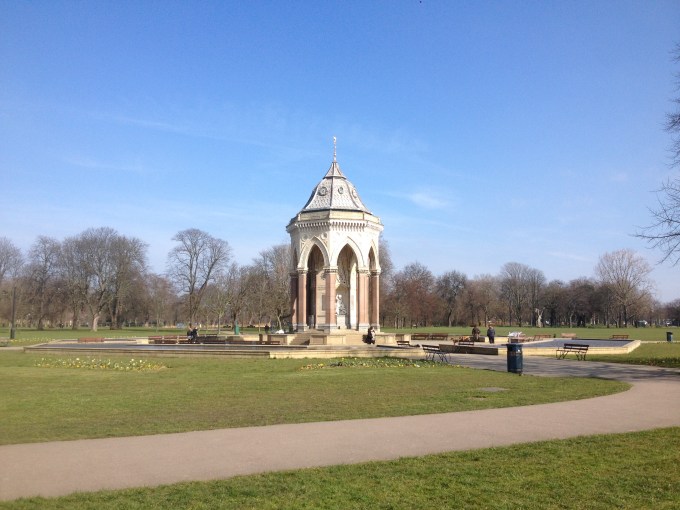
 Above: The Angela Burdett-Coutts Fountain at Victoria Park, London. [Image Copyright: Xinyu Guan]
Over March and April 2016, I conducted research into the history of Victoria Park, London, as part of a Master’s module on ecology and architectural history. I consulted primary materials at the London Metropolitan Archives, the Tower Hamlets Borough Archives, and the Bishopsgate Labour History Archives. The following is the abstract of the final write-up for the project:
“The current ecological crisis has intruded upon the domain of politics, calling into question the traditional distinction between ecology and politics as separate spheres of thought. Rather than focusing exclusively on human needs, desires and action, a new ecological, non-anthropocentric conception of politics must take into account non-human agencies and subjectivities, as scholars such as Bruno Latour and Jane Bennett have pointed out. Accounts of the entanglement of the human and the non-human, however, often run the risk of overemphasizing mixity, compositeness and fluidity, while paying little attention to the specificities of the human-nonhuman bodies themselves, and to the exclusions that separate them.
In this project, I examined the moment of emergence of previously unseen human-nonhuman bodies with under the rubric of demonstration – just as how demonstrators assemble on a city square, not just to be recognised as political subjects, but often to convey specific messages or demands. As Barry (1999) argues, the term demonstration has both the sense of a ‘public political protest’ and ‘witnessing a natural phenomenon or a technological possibility’ in a scientific sense (75).
Insofar as the unseen and unheard break through the partition of the sensible in an act of demonstration, this demonstration is not simply an assertion of the right to political subjectivity, but also a demonstration of interrelationality. Non-human political subjects are more than their potential to make their existence felt, more than their human-like complexities. A non-anthropocentric, ecological politics must not simply evaluate non-human political subjectivities in terms of their being for humans, or being like humans, but in terms of the relationships that they express – relations between different human-nonhuman political subjects, including relations of violence and exclusion. It is in this sense that the supposed mixity and the fluidness of the Anthropocene can be better formulated in terms of relationality: matter as demonstrative of interrelationality.
The final essay is composed of a series of fragments from the history of Victoria Park, a park in the East London situated between Bethnal Green and Hackney. Since its establishment in 1845, the park has served as a recreational space for residents of the nearby districts, as well as a site for political protests. I shall present various acts of demonstration involving various human-nonhuman bodies that have taken place in the park. It is impossible to exhaustively describe all the different kinds of demonstration in the park, or to produce a coherent historical narrative about the park as a demonstration ground. This essay shall instead present a couple of demonstrations in the form of fragments, which will be put in relation which each other at the end of the essay as a tentative constellation of interrelations – tentative, because each reading may perhaps yield new meanings and connections.”
For more information on this research project, please contact me via the following contact form:
Your message has been sent

 The New Bjork Times